
NeuroMD Review 2026: Does This Back Pain Relief Device Work?
Introduction
Back pain can make even an ordinary purchase feel urgent. When sitting, sleeping, or walking becomes uncomfortable, a small device promising lasting relief naturally attracts attention. This NeuroMD review examines whether the brand’s muscle-stimulation approach makes sense, what separates its products, and where expectations need adjusting.
The central question is bigger than whether electrical stimulation produces a noticeable sensation. Buyers need to know whether it could meaningfully improve daily comfort—and whether the price, replacement pads, and return conditions make the experiment worthwhile.
NeuroMD’s range includes a back-focused Corrective Therapy Device, a Whole Body Corrective Therapy Device 2.0, and a Foot & Lower Leg model. These products should not be treated as interchangeable.
Commercial disclosure: Purchase links lead to the manufacturer’s website. This review distinguishes manufacturer claims from published research and customer reports.
Check Today's Price
What Is NeuroMD?
NeuroMD Medical Technologies sells home electrical-stimulation devices directly to consumers. Its core proposition is making muscle stimulation accessible without repeated clinic visits. The back-focused product uses neuromuscular electrical stimulation, or NMES. Electrical impulses stimulate motor nerves, causing muscles to contract. This differs from conventional TENS, which primarily targets sensory nerves for pain modulation. NMES has established rehabilitation applications, although its usefulness depends on the condition, settings, and treatment plan.
The likely audience is someone who wants an additional home-care tool and values a compact, relatively simple system. That does not mean every cause of back pain responds to muscle stimulation. “Corrective Therapy” is the product name. It should not be interpreted as proof that the device corrects a slipped disc, reverses spinal degeneration, or removes nerve compression.
Key Features: What Actually Matters?
NMES and Muscle Activation
The main appeal is muscle activation rather than passive warmth or vibration. An NMES device delivers a stimulus that produces contractions, which may be incorporated into rehabilitation. For buyers, the relevant question is whether that approach fits their problem. Muscle weakness, nerve-related pain, and unexplained leg swelling are different issues. A device advertised across several symptom categories does not remove the need to understand the underlying condition.
Wireless, Rechargeable Design
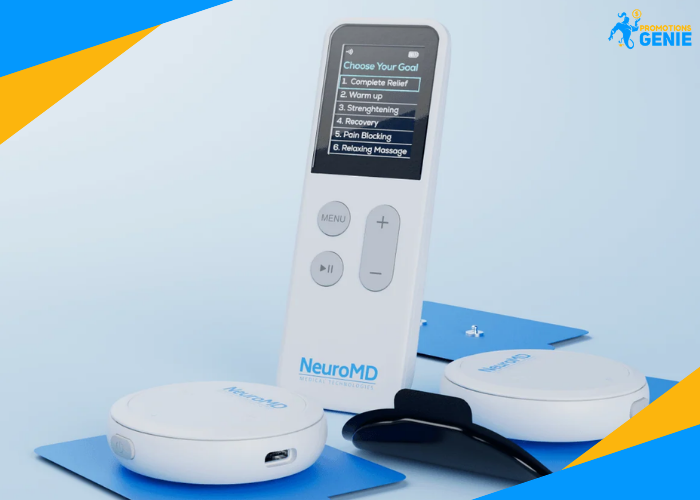
The back kit includes a stimulation device, rechargeable LCD remote, charging cable, treatment and exercise guidance, gel pads, and a storage pouch. Its wireless format reduces the clutter associated with leads running from electrodes to a separate controller. That convenience can matter. A treatment routine that is awkward to arrange may be abandoned even when someone initially feels motivated. Wireless operation still leaves practical tasks: charging components, positioning electrodes, protecting adhesive surfaces, and replacing worn pads.
Whole Body Corrective Therapy Device 2.0
For readers seeking a NeuroMD Whole Body Corrective Therapy Device 2.0 review, the important distinction is its advertised combination of NMES and TENS. The manufacturer also offers configurations with multiple stimulation devices controlled by one remote. This may appeal to someone considering treatment across more than one permitted area, but more devices do not automatically produce better results. Placement restrictions and the supplied instructions remain essential.
Choose this version because its functions suit your intended use, rather than because “whole body” sounds more comprehensive.
Foot & Lower Leg Mat
The Foot & Lower Leg product uses a mat-based format. It is a separate buying decision from the adhesive back device. Its listing contains inconsistent session descriptions, including references to 20, 25, and 30 minutes. Follow the instructions supplied with the exact model and obtain clarification from support when needed; combining website instructions into a self-designed routine is unwise. Anyone reading NeuroMD foot and lower leg device reviews should also distinguish general leg discomfort from diagnosed neuropathy or vascular disease.
First Impressions: Design, Setup, and Expectations
Because this review does not involve a purchased sample, packaging quality, delivery condition, battery endurance, and physical comfort cannot be independently scored. On paper, the back kit looks approachable: a compact device, remote, reusable electrodes, and written guidance. The design prioritizes a ready-made routine over extensive manual programming. That is useful for someone who finds complicated electrotherapy menus intimidating. A more experienced user may prefer greater control or a therapist-selected system.
The setup challenge is likely to be placement rather than pressing buttons. Someone with limited shoulder movement may struggle to reach the intended area of the back. Before ordering, consider whether another person would need to help. Expect an electrical treatment experience rather than a massage-chair sensation. A noticeable contraction may confirm that stimulation is occurring, but it does not establish that the cause of pain has been corrected.
Performance: Does NeuroMD Really Work?
What the Research Supports
There is a credible physiological basis for NMES: it can activate muscles and has rehabilitation uses. NeuroMD cites a 2011 paper reporting improvements in spinal-stabilizing muscle activation and pain ratings following NMES training. That supports investigating the treatment approach. It does not, by itself, prove that every current NeuroMD model produces the same outcomes in every buyer. Device configuration, patient selection, and treatment protocol matter. In the sources checked for this review, sufficient independent evidence was not verified to support a broad claim that the current devices reliably correct the underlying cause of back pain.
Where Everyday Benefits Might Matter
A useful result would be a meaningful improvement in ordinary activities: sitting through a meal, walking more comfortably, or completing recommended exercises with less difficulty. Those are better measures of value than how strong the stimulation feels. If a clinician considers the device appropriate, recording a simple baseline can help assess the purchase. Track one or two relevant activities consistently, rather than relying only on how a session feels immediately afterward.
Where Expectations Can Go Wrong
Pain varies naturally. Symptoms can improve alongside changes in activity, sleep, medication, or exercise. An improvement after starting a device does not establish how much the device contributed. The reverse also matters: feeling stimulation without functional improvement is not a reason to keep increasing intensity or extending sessions beyond the instructions. NeuroMD makes most sense as a possible adjunct. Treating it as a complete replacement for assessment and rehabilitation asks more of the product than the verified evidence supports.
NeuroMD Sciatica Reviews Need Careful Interpretation
Sciatica involves symptoms associated with irritation or compression of a nerve root. Marketing about muscle activation should not be read as evidence that a device decompresses that nerve. NICE advises against offering TENS for low back pain with or without sciatica. This recommendation concerns TENS and should not be presented as a direct evaluation of every NMES protocol, but it is relevant when assessing broad electrotherapy claims. Testimonials about sciatica relief are therefore individual experiences, not proof that the device resolves the underlying problem.
Foot-Stimulation Evidence Has an Important Limitation
A 2024 randomized, sham-controlled trial cited in this area investigated foot NMES using Revitive, not NeuroMD. It reported improvements in selected outcomes among older adults with lower-leg symptoms. The study also disclosed manufacturer funding. Its findings may support further interest in foot NMES, but they cannot simply be transferred to a different branded device or interpreted as proof of nerve repair.
NeuroMD Pricing and Value Analysis
The following advertised US prices were checked on October 16, 2026. Offers can change, and the final selected configuration determines the checkout price.
| Product or configuration | Advertised price |
|---|---|
| Corrective Therapy Device for Back Pain | $149.95 |
| Whole Body 2.0: one device and one remote | $179.95 |
| Whole Body 2.0: two devices and one remote | $229.95 |
| Whole Body 2.0: four devices and one remote | $279.95 |
| Whole Body 2.0: six devices and one remote | $319.95 |
| Foot & Lower Leg: one kit | $119.95 |
| Butterfly replacement pads | From $49 |
| Square replacement pads | $35 |
These are advertised selling prices, rather than independently established savings against a usual market price. Confirm electrode compatibility before ordering replacements.
Is the Premium Justified?
The strongest argument for paying more is convenience: wireless operation, a dedicated remote, and a predefined routine. The weaker argument is that a higher price must mean superior pain relief. Without a suitable head-to-head trial, that conclusion would be speculative. Start by identifying the smallest configuration that meets your needs. A larger bundle can lower the price per device while increasing the money committed to a treatment you have not yet tried.
The Return Policy Changes the Calculation
NeuroMD advertises a 60-day trial, but its published policy includes material conditions:
| Policy point | Published condition |
|---|---|
| Return window | 60 calendar days from delivery |
| Minimum trial | 30 days; labels available from day 31 |
| Opened returns | 15% medical waste disposal fee, plus shipping costs |
| Unopened returns | 10% restocking fee, plus shipping costs |
| Return label | $8.95 deducted from refund |
| Bundle sales | Listed as store credit only |
The policy also requires the original parts and accessories and sets a seven-day drop-off period after a return is initiated or a label supplied. Clarify whether your selected configuration counts as a bundle before payment. For perspective, 15% of a $149.95 purchase is approximately $22.49. Adding an $8.95 label produces about $31.44 in deductions, before any other applicable shipping costs. A trial can still be useful, but it should be budgeted as a potentially paid experiment.
Explore BRAND Collections
NeuroMD Pros and Cons
| Pros | Cons |
|---|---|
| Compact wireless treatment format | Clinical results remain uncertain for individual buyers |
| Rechargeable device and remote | Adhesive electrodes create recurring costs |
| Predefined programs simplify operation | Placement may require assistance |
| Separate back, whole-body, and foot options | Similar product names can complicate accessory selection |
| Home use may fit an existing care routine | Return fees reduce the value of the trial |
| NMES has legitimate rehabilitation applications | General NMES research is not equivalent to proof for each model |
Who Should Buy NeuroMD?
NeuroMD is most reasonable for someone who understands their symptoms, has checked that electrical stimulation is appropriate, and wants an additional home option. The back-focused model may suit a buyer who values simple controls over extensive customization. The Whole Body 2.0 deserves consideration when its combined functions and permitted treatment areas meet a specific need. The foot model requires its own assessment. Someone with diagnosed neuropathy, reduced sensation, or unexplained swelling should establish suitability before making a purchase.
| Buyer situation | Recommendation |
|---|---|
| Wants a simple adjunct to an established back-care plan | Reasonable to consider |
| Needs NMES and TENS functions | Compare Whole Body 2.0 with alternatives |
| Wants symptom relief at the lowest possible cost | Compare conventional TENS options first |
| Has unexplained foot numbness or swelling | Seek assessment before shopping |
| Requires a fully refundable trial | Published deductions may be unsuitable |
| Expects a permanent structural correction | Expectations do not match verified evidence |
Who Should Avoid It?
People with pacemakers or other implanted electronic devices should not use NeuroMD contrary to its contraindications. Pregnancy, epilepsy, heart conditions, impaired sensation, and recent surgery also require careful review of the exact model’s instructions and professional advice. Placement restrictions matter: the manufacturer warns against use over areas including the head, front of the neck, chest, or across the heart. This is not an exhaustive safety list. Skip the purchase if it would delay investigating new or worsening symptoms. It is also a poor financial fit if the potential return deductions or future electrode purchases would be difficult to absorb.
Customer Feedback: What NeuroMD Reviews Reveal
Customer experiences are mixed, even when the overall tone is favorable. Individual Trustpilot reviews checked for this article included reports of improved comfort and walking tolerance, helpful customer service, partial improvement, and no meaningful relief during standing or walking. One customer also described confusion when selecting compatible replacement electrodes.
These reports are useful for identifying ownership questions. They do not establish a treatment success rate, and reviews across the brand may involve different models. When reading NeuroMD back pain relief device reviews or NeuroMD corrective therapy device reviews, prioritize the exact model, duration of use, and functional changes described. A detailed account is more informative than an unexplained star rating.
NeuroMD vs TENS Units and Other Competitors
The NeuroMD vs TENS unit comparison starts with purpose. Conventional TENS emphasizes sensory stimulation for pain modulation; NMES aims to produce muscle contractions. Some devices combine both.
| Option | Main approach | Potential appeal | Main consideration |
|---|---|---|---|
| NeuroMD back device | NMES | Simple wireless back-focused system | Evidence, pad costs, return deductions |
| NeuroMD Whole Body 2.0 | NMES and TENS | Combined functions and multiple-device configurations | Match features to actual need |
| OMRON Max Power Relief | TENS | Dedicated symptomatic pain-relief option | Different purpose from muscle training |
| Compex Mini | EMS and TENS | Wireless stimulation with smartphone operation | App use and program selection |
| Revitive Medic | Foot-based NMES | Dedicated foot and lower-leg format | Different device and intended application |
OMRON markets Max Power Relief for muscle and joint pain relief. Compex Mini combines EMS and TENS with app control, while Revitive Medic focuses on lower-leg symptoms through foot-based stimulation. Availability and specifications vary by market. None should be ranked solely by advertised power or number of programs. The better purchase is the one suited to the intended use, with clear instructions and acceptable ownership terms.
Frequently Asked Questions
1. Does NeuroMD really work?
Some users report benefits, and NMES has legitimate rehabilitation applications. However, the sources checked do not establish that current NeuroMD models reliably resolve back pain or correct its cause. Individual outcomes vary.
2. Is NeuroMD the same as a TENS unit?
No. The back-focused device emphasizes NMES, which produces muscle contractions. Conventional TENS primarily targets sensory nerves for pain modulation. The Whole Body 2.0 is advertised as combining both technologies.
3. Can NeuroMD cure sciatica?
A cure has not been established by the evidence verified for this review. Reports of symptom relief should not be interpreted as proof that the device removes nerve-root compression.
4. How quickly should results appear?
There is no dependable timeline for an individual buyer. Follow the supplied protocol and assess meaningful changes in daily activities rather than expecting an immediate or guaranteed result.
5. Is the Whole Body 2.0 better than the back device?
It offers a different feature set, including advertised NMES and TENS functions. That may make it more suitable for certain uses, but it does not establish superior results for everyone.
6. Do the foot and lower-leg devices repair nerves?
The research checked does not establish that NeuroMD repairs damaged nerves. A cited foot-NMES trial tested Revitive, so its outcomes should not be treated as direct validation of NeuroMD.
7. Is NeuroMD safe for everyone?
No. Implanted electronic devices and other health circumstances can make electrical stimulation inappropriate. Read the exact model’s contraindications and obtain professional guidance when suitability is uncertain.
8. Are replacement electrodes an ongoing expense?
Yes, for adhesive-pad models. Electrode life varies, so include replacements in the ownership budget and confirm compatibility before ordering.
9. Is the 60-day NeuroMD trial completely refundable?
The published policy includes deductions and conditions. Opened returns carry a 15% fee plus shipping costs, while bundle sales are listed as store credit only.
10. Where should you buy NeuroMD?
The manufacturer’s website provides the current range and purchase terms. Confirm the exact model, selected configuration, final price, and return conditions before paying.
Final Verdict: Is NeuroMD Worth Buying?
NeuroMD is worth considering for a defined purpose: convenient home electrical muscle stimulation within an appropriate care plan. Its strongest qualities are practical. Wireless operation and straightforward controls may make regular use easier. Its limitations are equally relevant: uncertain individual benefit, recurring electrode expenses, and a trial that can involve meaningful deductions. Buyers expecting a guaranteed sciatica cure, nerve repair, or permanent correction of spinal problems should skip it. Buyers who understand the evidence limits and can comfortably absorb the potential trial cost may find a single suitable kit worth considering. Final editorial rating: 7/10. Convenience supports the score; evidence limitations and purchase conditions keep it from rating higher.
Shop BRAND Now
At PromotionsGenie, we are dedicated to helping you shop more intelligently, spend more judiciously, and find superior value online. Regardless of whether you are a student, a parent, a fashion enthusiast, or just a sensible shopper, we link you to dependable savings opportunities and trustworthy buying options from your preferred brands across the globe
Subscribe
Sign up below to receive money-saving tips, frugal ideas, family-friendly recipes, and more.